


 Cart
Cart
 sales@molnova.com


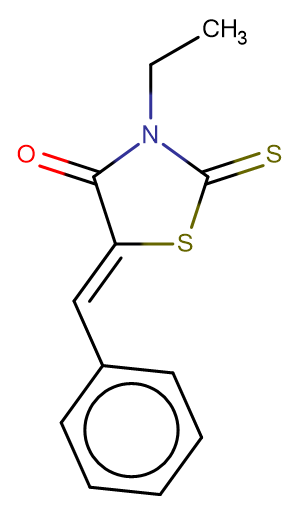
5-Benzylidene-3-ethyl rhodanine
CAS No. 18331-34-5
5-Benzylidene-3-ethyl rhodanine( —— )
Catalog No. M20405 CAS No. 18331-34-5
5-Benzylidene-3-ethyl rhodanine(BTR-1) is an active anti-cancer agent. BTR-1 activates apoptosis and induces cell death.
Purity : >98% (HPLC)
 COA
Datasheet
HNMR
HPLC
MSDS
Handing Instructions
COA
Datasheet
HNMR
HPLC
MSDS
Handing Instructions
| Size | Price / USD | Stock | Quantity |
| 2MG | 71 | In Stock |


|
| 5MG | 110 | In Stock |
|
| 10MG | 177 | In Stock |
|
| 25MG | 332 | In Stock |
|
| 50MG | 478 | In Stock |
|
| 100MG | 691 | In Stock |
|
| 200MG | Get Quote | In Stock |
|
| 500MG | Get Quote | In Stock |
|
| 1G | Get Quote | In Stock |
|
Biological Information
-
Product Name5-Benzylidene-3-ethyl rhodanine
-
NoteResearch use only, not for human use.
-
Brief Description5-Benzylidene-3-ethyl rhodanine(BTR-1) is an active anti-cancer agent. BTR-1 activates apoptosis and induces cell death.
-
Description5-Benzylidene-3-ethyl rhodanine(BTR-1) is an active anti-cancer agent. BTR-1 activates apoptosis and induces cell death.
-
In VitroBTR-1 (10, 50, 100, and 250 μM, 5 days) dose-dependently causes cytotoxicity in human leukemic cells, with IC50s of 8 and 6 μM at 48 and 72 h, respectively.Cell Viability AssayCell Line:T-cell leukemic cell lines Concentration:10, 50, 100, and 250 μM Incubation Time:5 days Result:Induced cytotoxicity in human leukemic cells in a dose-dependent manner.
-
In Vivo——
-
Synonyms——
-
PathwayApoptosis
-
TargetApoptosis
-
RecptorApoptosis
-
Research Area——
-
Indication——
Chemical Information
-
CAS Number18331-34-5
-
Formula Weight249.35
-
Molecular FormulaC12H11NOS2
-
Purity>98% (HPLC)
-
SolubilityDMSO:25 mg/mL (100.26 mM)
-
SMILESCCN1C(=S)S\C(C1=O)=C/c1ccccc1
-
Chemical Name——
Shipping & Storage Information
-
Storage(-20℃)
-
ShippingWith Ice Pack
-
Stability≥ 2 years
Reference
1.Moorthy B T Ravi S Srivastava M et al. Novel rhodanine derivatives induce growth inhibition followed by apoptosis[J]. Bioorganic and Medicinal Chemistry Letters 2010 20(21):6297-6301.
molnova catalog



related products
-
Tebufenozide
Tebufenozide is a novel nonsteroidal ecdysone agonist.
-
(R)-Isomucronulatol
(R)-Isomucronulatol (2H-1-Benzopyran-7-ol), a flavonoid that can be extracted from the leaves of Astragalus membranaceus, Sophora japonica, Sclerotium tigrinum, and Glycyrrhiza glabra, inhibits the proliferation and apoptosis of BMSCs in the TNF-α microenvironment.
-
RSH-7
RSH-7 is a potent dual inhibitor of BTK and FLT3, with IC50s of 47 and 12 nM, respectively.RSH-7 has antiproliferative and antitumor activities, inducing apoptosis and inhibiting BTK and FLT3 signaling.
